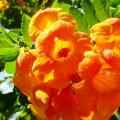
Carroty color, a
rapid growth rate
resulting in quick-mass coverage, and a willingness to climb anything are just a few of the reasons gardeners turn to Campsis radicans, commonly known as Trumpet Creeper.
Attracting hordes of
hummingbirds,
terrific trumpets of
pumpkin-orange
blossoms
dangle like jewels from June through September on
deciduous,
emerald foliage that has a
twining
habit.
A
native
to designated zones, Trumpet Creeper's
vine
is very aggressive (will climb 30-40 feet) making it a splendid option for long, empty fence lines (where
birds
will go crazy building nests) or a large pergola in the backyard.
Trumpet Creeper's vigorous nature is
drought tolerant
and an effective
naturalized
groundcover.
Its
pinnate-compounded,
ovate
leaves (1-4 inch long) offer emerald green new foliage that matures into a rich forest green, giving dense coverage.
Trumpet Creeper's stems have aerial roots that can cling to walls, trees, and fence-posts.
These tendrils will eventually mature into heavy, woody stems several inches in diameter.
For best flowering, you'll want to be certain Trumpet Creeper has adequate sun
(
full sun
in the north and
full
to
part sun
in the south).
Though Trumpet Creeper will flourish in woodland gardens, against privacy fences, and any other sunny structure, our favorite spot for Trumpet Creeper is along a pergola or arbor where her yellow-throated, orange trumpet-blossoms can dangle like topaz gemstones from the emerald foliage.
Interesting Facts
The Trumpet Creeper (sometimes called Trumpet Vine) hails from the Bignoniaceae family.
It is native to woodlands of the Southeastern United States, but is a popular perennial across much of the country
Things to Note
Outside of its native range, this species has the potential to be highly invasive, even as far north as New England.
Trumpet Creeper can and will destroy weak supporting structures such as old decking or flimsy arbors.
Wherever you plant this hardy perennial, be absolutely certain the surrounding structures can support its growth.
These may appear to be dead sticks when you receive them.
They are not; be patient, and once you have warm nights, they will send up shoots and eventually blossom.
Gardener Tips
Unless you have a space where this plant can truly take over, you will want to ruthlessly prune each year.
Along an extended fence line, we think you'll love the combination of
Black Eyed Susan,
Purple Coneflower,
Liriope muscari,
and Trumpet Creeper.
The lovely bright flowers will attract birds that will nest in the Trumpet Creeper and feed on Muscari's berries in late season.
Please read
about bare root plants
(especially the paragraph about bare root grasses) so you know what to expect.


 (0)
(0)
 Full sun
  Part sun
  Shade
Shade