General information about Hedera helix:
Hedera ivies are tricky to water properly, especially if planted in summer.
See the Care tab for advice about watering and the Shipping tab if you are considering planting them in warm weather.
Hedera ivies tolerate full sun in northern zones (up to zone 6) and require at least partial shade in zones 7 and above.
The word "helix" is derived from the Ancient Greek word for "twist, turn" and refers to spirals in the leaves.
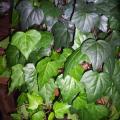
Hedera helix plants are also known as Ivy, Common Ivy, or English Ivy and are native to most of Europe and southwest Asia.
When there are suitable surfaces (e.g. trees, cliffs, walls), this
evergreen
climbs
up to 100 feet; when there are no vertical surfaces, it grows similarly well as a ground cover.
Hedera helix's short rootlets adhere to tree bark and rock, aiding longer climbs.
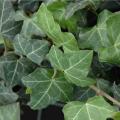
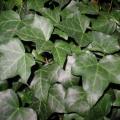
The leaves are alternate and 1 1/2- to 3-inch long, with 1- to 4-inch long
petioles.
Hedera offers two different leaf types when she is exposed to
full sun
locations like the top of a rock face, a southern building façade or the crowns of trees, creating lovely interest. These leaves,
palmately lobed
juvenile leaves on creeping and climbing stems, and
unlobed,
cordate,
adult leaves on fertile flowering stems, add both texture and variety with juvenile shoots being slender, flexible and willing to climb using tiny roots to attach themselves to surfaces like rock or tree bark and adults shoots that are both thicker and self-supporting with no roots.
In late Autumn, expect small, individual flowers blossoming in 1 to 2 inch greenish-yellow
umbels.
and in late winter, expect small blackberries that will thrill a variety of
birds.
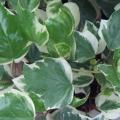
Gardeners love Hedera Ivies because of their uniquely-shaped leaves and their
evergreen
often
variegated
foliage that promises to add texture, variety and constant color to their landscape. Famously, Hedera is known for its skill in adorning unsightly walls.
Things to Note
The esthetic, camouflaging of Hedera lands her into a bit of a debate. There has been disagreement as to whether it is harmful to the object being climbed by ivy; the consensus in Europe is that the effect is mostly insignificant. In fact, soundly-mortared walls are generally considered to be impenetrable to ivies’ climbing roots. Those who follow this frame of thinking will argue that walls are actually protected from weathering due to a shield of ivy keeping the elements off mortar. Walls with already weak or loose mortar, however, may be susceptible to damage, as ivy can cause breaks by rooting into the mortar. Subsequent removal of the ivy can be difficult, and is likely to cause more damage than the ivy itself. Modern mortars (that contain Portland cement and a little lime) are stronger than older mixes; the latter were largely composed of sand and lime. Most mortar mixes changed to contain Portland cement in the 1930s, though soft mortar is still used when laying softer brick.
At the same time, when the object is living, such as a tree, both may compete for ground nutrients and water, and trees with heavy growths of ivy are more liable to
windthrow,
North America sees greater dangers, as trees run the risk of perishing after becoming overworked. This could be due to the difference between native plants and those plants being introduced from other regions. In North America, Hederas lack the natural pests and diseases that control its vigor in native areas. Gardeners will want to consider the potential of this ivy to create a
vigorous,
dense,
shade-tolerant
evergreen
that can
spread
over large areas and out-compete native vegetation.
|


 (0)
(0)
 Full sun
  Part sun
  Shade
Shade