To be published in the December Takoma and Silver Spring Voice
newspapers.
By now we're all convinced of the many great reasons to grow our own
food, like better taste and nutrition, saving money, avoiding
long-distance shipping, and knowing exactly what's in the food we
eat. But growing fruit trees in Mid-Atlantic humidity can be a
challenge, especially if you're a low-maintenance gardener.
First there's the regular pruning that fruit trees need if they're
to produce fruit you can reach or in some cases, produce fruit at
all. It's a lot more complicated than no-brainer pruning like
hacking back to a uniform height; it means opening up the branch
structure, for example, and that takes some skill. So how to
learn? You can ask the person who sells you the tree for guidance,
and some mail order suppliers provide care guides that describe the
pruning required. If all else fails, research online because
pruning is a must.
But Cindy Brown, edibles expert at Virginia's Green Springs Garden,
warns growers not to rely too much on pruning, saying that reducing
overall size is the worst reason to prune. She believes it's far
better to choose a plant that's the right size for where it's growing,
and prune for other reasons – to improve health and
productivity. She also recommends starting the pruning
process when the plant is young rather than trying to rejigger its shape
later.
The good news for suburban gardeners is that so many fruit trees are
dwarf in size and fit well in smaller gardens, even in pots on a
patio. Most need lots of sun, though, for health and productivity,
and that means six hours a day.

Here are the most popular fruit trees for the D.C. area, starting
with the easiest to grow. They can be planted as soon as the
ground is diggable in March.
Figs
The easiest fruit tree in this area is undoubtedly the fig, which
will fruit with as few as four hours of sun per day, is fairly
pest-free, and can be grown as a shrub, a small tree or a large one. Washington Gardener editor
Kathy Jentz describes figs as easy to propagate and "fairly
low-maintenance compared to other edibles." No spraying is needed,
and deer avoid them. They do require winter protection, at least
for their first few years (for example, by planting them close to a
building or wrapping them in burlap). Jentz warns that "Your
biggest challenge will be fighting the birds and squirrels for their
bounty." And if wasps and yellow jackets arrive to devour the ripe
fruit, hang a trap for them. One supplier recommends adding lime
around the base in spring, summer and fall.
Cindy Brown is also a big fan of figs, adding that they're
"sumptuous in recipes and absolutely delicious!" But that's not
all – they're full of vitamins and have a higher fiber content than any
other fruit, can be eaten fresh or frozen, dried, or made into
preserves. The best varieties are ‘Brown Turkey', ‘Celeste',
‘Marsailles' and ‘Hardy Chicago'.
 Pawpaws
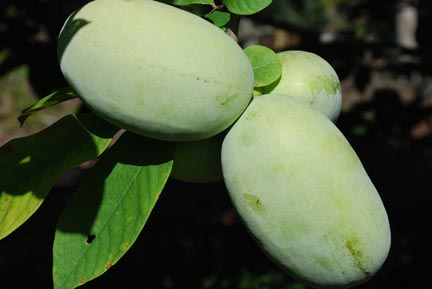
These native trees do well in our area, are beautiful in bloom and
yield fruit in three to eight years after planting. At least two
are needed for pollination, and these 40-foot trees are not for tiny
patio gardens. Some local gardeners avoid pawpaws because of their
reputation for attracting raccoons but Michael at Edible Landscaping
tells me that raccoons can be avoided by picking up the ripe fruit as
soon as they land on the ground – that very morning. And according
to Scott Aker of the National Arboretum, Japanese beetles may
occasionally damage the leaves, but pawpaws have no serious pest or
disease problems and rarely need to be sprayed. Fortunately, deer
avoid them because of the bitter compounds found in the twigs.
Most sources say that pawpaws require full sun to fruit but should
be shielded from the sun for their first two years, and Aker suggests
building a small frame with stakes and covering the top with a piece of
burlap or erosion-control fabric to provide the temporary shade
needed. (But then a local supplier tells his customers to
just plant pawpaws in full sun and leave them be, so choose your
advice.) Aker also says it's essential to provide the young trees
with consistent moisture in their first year.
And this is interesting, also from Aker: "Sometimes pawpaw trees
fail to fruit even if another pawpaw is planted close by. The flowers,
which appear in early spring, are flesh-colored and carry the faint odor
of rotting meat. The smell may not be strong enough to attract the
blowflies and carrion beetles that typically pollinate pawpaws. If your
pawpaws flower but do not set fruit, you may want to try placing a piece
of meat in the vicinity of the trees to draw flies at the time the
flowers are open." Who knew?
Asian Persimmons
Kristi Janzen at Edible
Chesapeake Magazine had great success with an old persimmon tree
that eventually outlived its 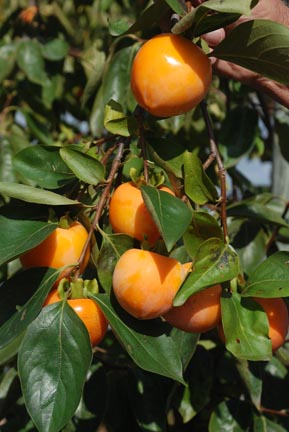 productive
lifespan, so she recently planted a ‘Saijo' for its small, elongated
fruit and a ‘Hachiya' for its rounder, larger fruit. "They require
almost no care, and do well in the climate around metro Washington,
DC." She also explained that Asian persimmons are more popular
than the American ones because they bear larger fruit and the trees
themselves are much smaller and fit into urban gardens. Also,
unlike American persimmons, they don't need male and female trees to
produce fruit. She advises "waiting until they're ripe – that is,
when they are soft to the touch, almost like an overripe tomato.
Only then will they be sweet and delicious. Persimmons can also be
dried."
productive
lifespan, so she recently planted a ‘Saijo' for its small, elongated
fruit and a ‘Hachiya' for its rounder, larger fruit. "They require
almost no care, and do well in the climate around metro Washington,
DC." She also explained that Asian persimmons are more popular
than the American ones because they bear larger fruit and the trees
themselves are much smaller and fit into urban gardens. Also,
unlike American persimmons, they don't need male and female trees to
produce fruit. She advises "waiting until they're ripe – that is,
when they are soft to the touch, almost like an overripe tomato.
Only then will they be sweet and delicious. Persimmons can also be
dried."
Cindy Brown also loves Asian persimmons, adding that they're rarely
bothered by pests. Persimmons range in size from 15 to 40 feet and
will fruit in two to three years after planting.
Peaches and Apples
Members of the rose family, peaches and apples are showy but suffer
from damage by insect pests and persistent fungal disease in our humid
summers, which problems are particularly frustrating to local gardeners
hoping to avoid spraying with pesticides. In fact, local experts
say that the only way to grow them successfully is to spray
regularly. Commercial growers use systemic (and nonorganic)
fungicides that remain after a rain but organic-only products must be
reapplied regularly plus after each rain. It may be the lack of
that strict regimen of spraying that accounts for the failure of so many
organic gardeners to successfully grow peaches and apples.
But whether you choose an organic or nonorganic pesticide, make sure
it's formulated specifically for crops. One organic
insect-deterrent recommended by Edible Landscaping is the clay-based
product Surround, which prevents insects laying eggs on the fruit.
To keep birds and squirrels from eating your crop, netting is the only
solution. And one local gardener told me that her Jonathan apple
crop is routinely ruined by worms, despite her best efforts with organic
pesticides.
Peaches seem to fare better because pest-resistant varieties are
fairly successful, even in our area, though one grower told me that a
particularly wet year can ruin a entire peach crop. Overall, a
little attitude adjustment goes a long way in growing apples and peaches
– learning to accept blemishes and some insect damage.
Cherries
With cherries, too, a wet year can ruin the crop, and here in the
suburbs, birds are the biggest pest growers have to contend with.
In selecting a variety, check whether it self-pollinates or requires a
mate, and also its ultimate size because some grow to 40 feet. For
small gardens Kristi Janzen recommends ‘Northstar,' for sour pie-making
cherries and ‘Krymst' or ‘Geisla' for the sweet ones.
 Asian Pears
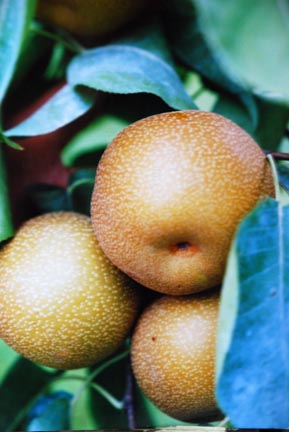
The staff at Behnkes Nursery tell me that along with figs and
persimmons, Asian pears are their top selling fruit trees (followed by
apples, peaches and cherries.) They do require spraying, however,
and regular pruning to keep them low enough to reach without a
ladder.
Where to buy fruit trees
For their help writing this article, thanks to Kathy Jentz, Cindy
Brown, Kristi Bahrenburg Janzen at Edible Chesapeake
Magazine, Edible Landscaping Co, Casey Trees, Behnkes Nursery, and
Scott Aker.
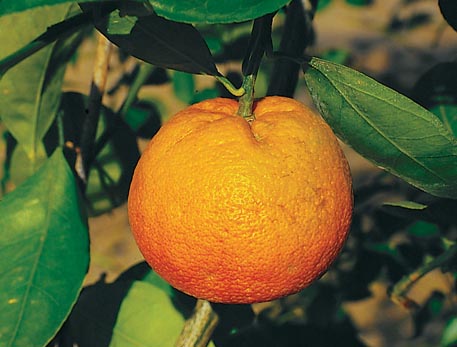
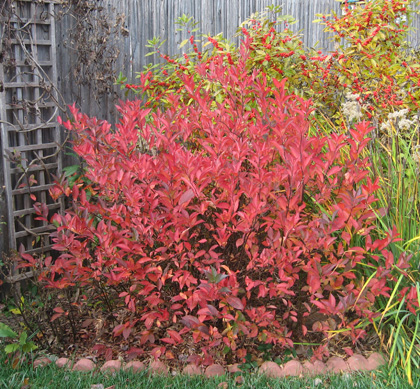
Thanks to Edible Landscaping for the use of these photos.




 I
I