 (0)
(0)
Spurge (Euphorbia)
Euphorbia is a genus of astonishing range, from tiny annual weeds to Mediterranean spurges, cushion-forming perennials, succulent shrubs, and poinsettias, yet many members share a distinctive botanical grammar. Their flowers are reduced into cyathia, small cup-like structures often surrounded by showy bracts that do the ornamental work usually assigned to petals. Leaves may be narrow, glaucous, variegated, leathery, or fleeting, and the stems can be herbaceous, woody, or succulent. The genus often reads as sculptural, with color and form integrated into the architecture of the plant.
In temperate gardens, perennial spurges are valued for chartreuse, lime, cream, or yellow-green bracts that glow in spring and early summer, pairing beautifully with tulips, dark foliage, grasses, and silver leaves. Some species offer blue-gray foliage, red-flushed stems, or evergreen rosettes that remain handsome long after flowering. The beauty is clean, sometimes austere, and often very modern, because the plant depends less on softness than on contour, repetition, and unusual color. At the same time, the milky latex common to Euphorbia is irritating to skin and eyes and should be handled with care.
Culture varies widely, but many ornamental spurges prefer sun to light shade and well-drained soil, with drought tolerance more common than tolerance of winter wet. A few species seed freely or spread aggressively in favorable climates, while tender types must be protected from cold. Gloves, thoughtful siting, and prompt removal of unwanted seedlings are sensible. Euphorbia is most rewarding when its particularity is respected. It brings a polished, acid-green brightness and a structural confidence that can sharpen a border, making softer plants seem more deliberate by contrast.
The best compositions use Euphorbia as a color temperature tool. Its chartreuse bracts can make blues look deeper, purples richer, and tulips more sophisticated, while gray-leaved species bring dryland calm to gravel or Mediterranean plantings. Because the sap is a real hazard, cutting stems should be done with gloves and eye protection, and arrangements should be handled carefully. Its elegance is therefore disciplined in both appearance and practice, which suits the genus perfectly.
See photographs comparing average sizes of some bare roots and potted plants
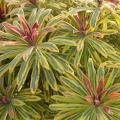 | Spurge 'Ascot Rainbow' {1-Gallon pot} 1 - 9: $38.47 each | 10 - 99: $36.55 each Spurge 'Ascot Rainbow' grows to 20 inches and prefers full sun. Its colorful foliage features a mix of greens, yellows, and reds, adding a vibrant and dynamic element to your garden. In stock. |
| Spurge 'Ascot Rainbow' {tray of 72 cells} 1 flat of 72 cells: $239.76 ($3.33 per plant) Spurge 'Ascot Rainbow' grows to 20 inches and prefers full sun. Its colorful foliage features a mix of greens, yellows, and reds, adding a vibrant and dynamic element to your garden. Temporarily out of stock. Expected 10/12/2026. |