 (0)
(0)
Fir (Abies)
Abies, the true firs, gives the landscape one of its most dignified evergreen structures. These conifers commonly grow with tiered branches and a central leader, and their needles are usually borne singly rather than in bundles, often feeling softer and flatter than those of many spruces or pines. On the young growth, silvered undersides or blue-green wax can lend a cool luminosity, while mature trees develop a steadiness that reads as shelter, shade, and permanence. Even compact garden selections keep something of that composed mountain character, holding their foliage in ordered sprays rather than ragged tufts.
The cones are distinctive, standing upright on the branches and gradually breaking apart while still on the tree, so they are not usually found intact on the ground. New shoots can be tenderly colored in spring, and in many species the buds, resin, bark, and needles carry a clean balsamic scent when warmed or brushed. Firs are not quick ornaments in the manner of bedding plants; their beauty gathers slowly through repetition of branch, needle, shadow, and seasonal sheen. In winter, snow rests along their layered boughs with particular calm, and in summer their cool surfaces give depth beside deciduous foliage and flowering shrubs.
Most Abies species favor cool conditions, even moisture, and acidic to neutral soils with good drainage; many struggle where summers are hot, air is dry, or soil is compacted. Their roots resent stagnant wetness as much as drought, and generous spacing is important because the symmetry of the tree is easily spoiled by crowding. Dwarf and slow-growing cultivars make the genus accessible in smaller gardens, where a single blue, silver, or deep green fir can become a measured vertical presence. Chosen with climate in mind, Abies offers a kind of polished austerity: tactile needles, resinous freshness, and a silhouette that steadies the planting around it.
Because firs register strongly in winter, their companions should leave room for the lower branches and the shadow they cast. Low heaths, ferns, woodland perennials, or restrained groundcovers can make the base feel settled without competing with the tree’s slow authority. The result is a planting that feels protected and cool even in the bare months.
See photographs comparing average sizes of some bare roots and potted plants
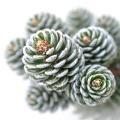 | Korean Fir 'Ice Breaker' {3-Gallon pot} 1 - 9: $417.97 each | 10 - 99: $397.07 each Korean Fir 'Ice Breaker' is a miniature conifer with tightly curled needles that reveal bright white undersides for a frosted look. Slow growing to about 36-39 in. tall in full sun to part shade. Temporarily out of stock. Expected date unknown. |